Verifying Casino Licences & Operator Security in the UK
 Available in GB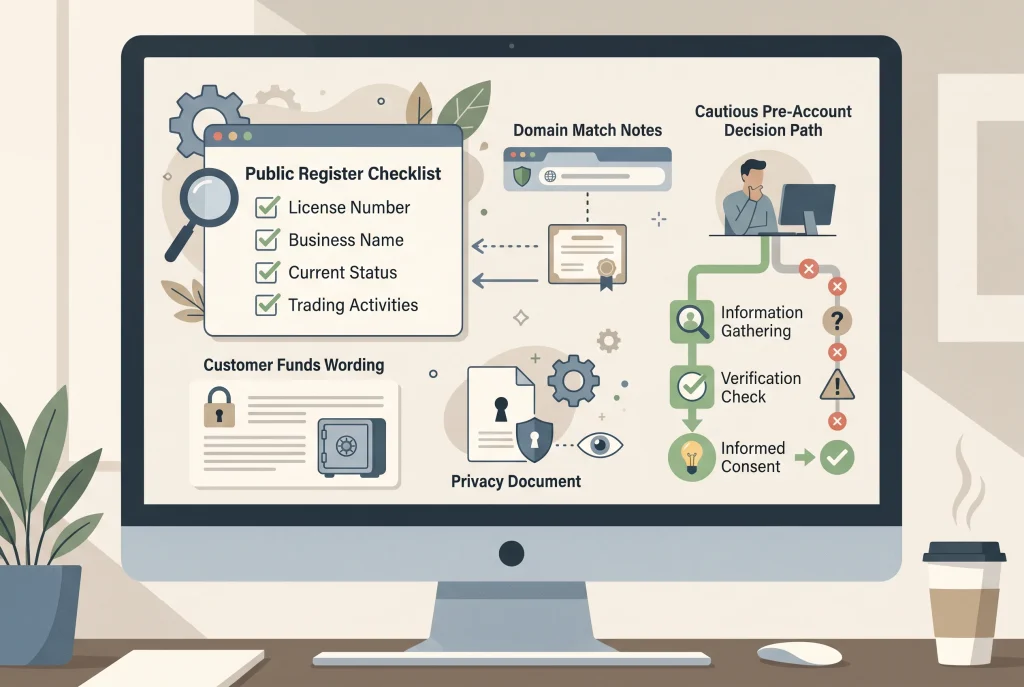
Before you open an account, deposit money or upload identity documents, it is worth slowing down and checking what can be checked from public records and the site’s own terms. A check is not a guarantee that a gambling site is suitable, fair or low-risk. It is a way to spot mismatches, missing information and claims that deserve caution before you hand over money or personal data.
This guide focuses on pre-account checks. It does not rank gambling sites, name operators or suggest that a site outside a protection tool is a safer choice. If you are on GAMSTOP, have set a bank gambling block, or are trying to stop gambling, these checks should not be used as a route back into gambling. In that situation, the safer page to read is GAMSTOP, bank blocks and support options.
Validating Operator Details on Official Gambling Registers
For gambling licensed in Great Britain, the Gambling Commission provides public registers and a register of gambling businesses. Those records can be searched by business name, trading name, domain name or account number when that information is available. That matters because a gambling site may display a brand name while the licence belongs to a different legal business. The useful question is not “does the page look professional?” but “can I match the name, domain and business details to an official record?”
Use the register as a check, not as a recommendation. A match tells you that the details you searched appear in an official record. It does not tell you that a site is right for you, that every promotion is good value, that withdrawals will be fast, or that gambling is a sensible decision. A mismatch, missing domain, unclear legal name or vague licence claim should make you stop and look again before entering payment details.
The Gambling Commission’s public registers and register of gambling businesses are the places to start for Great Britain-licensed gambling. If a site gives a licence number, business name or trading name, search the exact wording and compare it with the domain you are actually using. Do not rely only on a badge, footer line or image of a certificate on the gambling site itself.
After verifying the official licence, you should also review how the operator handles personal data and account security to protect your sensitive information.
Before you create an account: six checks
| Check | What to look for | What it cannot prove |
|---|---|---|
| Register search | Search by business name, trading name, domain and account number where available. Compare the official record with the exact website you are visiting. | It does not prove that the site is suitable for you or that every term is fair in your situation. |
| Domain and legal name | Look for the legal business behind the site, the trading name and the domain listed in the official record or in the site’s terms. | A similar name is not enough. A copied badge or vague footer line should not be treated as proof. |
| Customer-funds wording | Read how account balances are held and what level of protection is disclosed if the business fails. | Gambling account balances are not protected in the same way as personal bank accounts. |
| Terms and withdrawal rules | Check withdrawal conditions, identity checks, bonus conditions, dormant-account wording and reasons an account can be restricted. | A simple sign-up page does not remove rules that appear later in full terms. |
| Privacy and documents | Look for clear privacy information before sharing identity, address, payment or financial information. | A site asking for documents does not automatically mean it is unsafe, but unclear handling is a warning sign. |
| Complaint route | Find how to complain to the business and whether an approved dispute route is described if the complaint is not resolved. | A complaint route does not promise a refund, a fast result or a particular outcome. |
Read the customer-funds wording before you deposit
Many people check bonuses and payment logos before they check how their account balance would be treated if a gambling business failed. The Gambling Commission explains that money held in a gambling account is not protected like money in a personal bank account. Licensed businesses that hold customer funds must disclose their arrangements, and the wording can differ. That is why the customer-funds section belongs in a first check, not at the end of a dispute.
Look for plain wording about whether funds are segregated, whether they are protected from insolvency and what level of protection the business says applies. Avoid turning this into a ranking exercise. The point is to understand the risk you are taking before you deposit. If the wording is hard to find, buried in long terms or written in a way you cannot understand, that is a practical reason to pause.
This check connects to payment and withdrawal questions, but it is separate from them. The deeper payment guide explains identity checks, credit-card restrictions and withdrawal timing. Here the question is narrower: before any account is created, can you find and understand the basic money-risk disclosures?
For a comprehensive overview of safe offshore operators, check our main guide to casinos not on Gamstop before registering.
Check terms before you accept a bonus or upload documents
A gambling site can ask for age and identity checks, and in some circumstances further risk-based information may be relevant. That is not a reason to look for “no checks” claims. It is a reason to read what the site says before you share documents. The more sensitive the information, the more important it is that the site explains why it is being collected, how it is handled and what happens if you do not provide it.
Terms deserve the same attention. Check whether withdrawals can be delayed by bonus conditions, open verification requests, source-of-funds questions, payment-method rules or account restrictions. Also check how the site explains promotional eligibility, wagering, maximum stakes connected to a bonus, expiry and account closure. You do not need to memorise every clause before you decide; you do need enough clarity to avoid being surprised by a rule that was available before deposit.
Know the complaint path, but do not treat it as a safety net
The Gambling Commission tells consumers to complain to the gambling business first. Its consumer material also points to escalation through an alternative dispute resolution route when a complaint cannot be resolved after the relevant process. Regulator material refers to an eight-week point before ADR escalation in this context, but that should not be read as a promise of success or a fixed result for every situation.
Before creating an account, look for the complaint page, the contact method, the timeframes described by the business and any approved dispute route named in the terms. Save copies of terms at the time you accept them, deposit confirmations, chat transcripts and withdrawal messages. Clear records matter because a later complaint is usually easier to explain when dates, amounts, terms and messages are not reconstructed from memory.
What to do when something does not match
If the domain does not match the register, the legal name is unclear, the customer-funds wording is missing, the site pushes vague “instant withdrawal” claims, or the privacy information is thin, do not try to fill the gaps with assumptions. Treat the missing detail as the finding. You may decide not to create an account, or you may ask the business for clarification before sharing money or ID. If the answer is evasive, that is also useful information.
Keep the checks in order. First, confirm the public-record details. Second, read the money and privacy terms. Third, look at the complaint route. Fourth, decide whether the risk still makes sense for you. If the reason you are searching is that a protection tool is blocking gambling, stop the checking process and read the support guide instead. Protection tools are there because gambling can become difficult to control, and trying to work around them can make the situation worse.
Next steps for checking a site safely
- Understand payments, verification and withdrawals if your main concern is deposits, identity checks or getting money out.
- Read about bonus terms, withdrawals and complaints if a promotion or dispute is the main issue.
- Check personal data and account security before uploading ID or financial information.
- Use the support guide if GAMSTOP, bank blocks, debt or loss pressure are part of the reason you are here.