
Account Data Security & Privacy Protection at UK Casinos
 Available in GB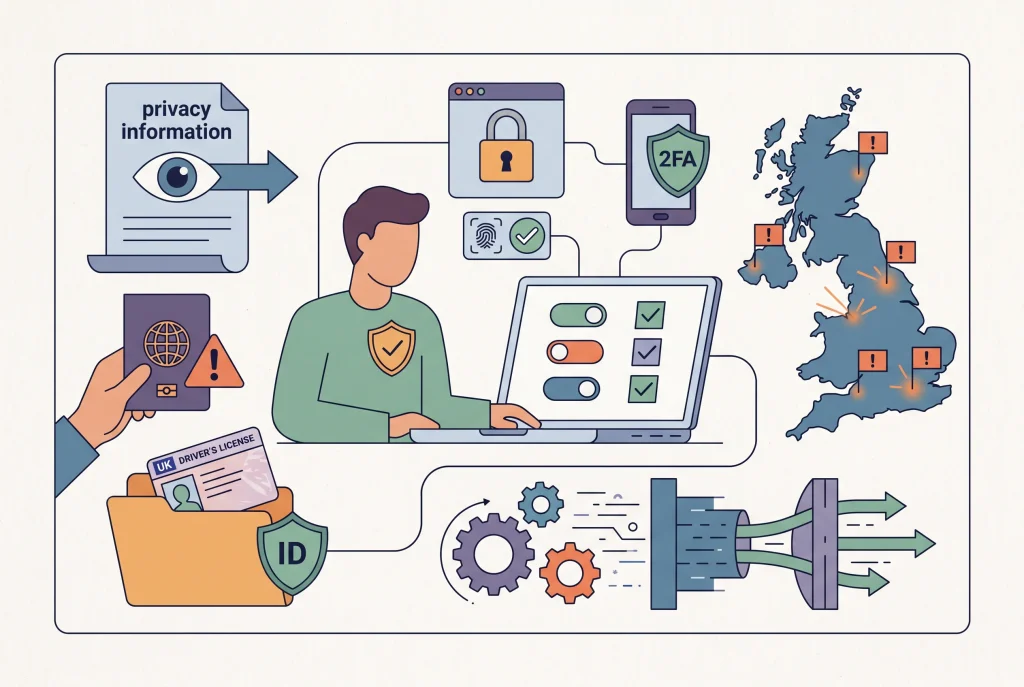
Opening an online gambling account can involve more than a username and a deposit. A site may ask for name, date of birth, address, payment details, identity documents, financial information, cookie choices and contact preferences. Some checks can be part of ordinary account controls, but that does not mean every request should be accepted without reading how the information will be used and protected.
This guide focuses on data handling and account security. It does not tell you how to avoid checks, hide identity information or fabricate documents. It also does not certify any gambling site. The aim is to help you decide whether the privacy information, document process and warning signs are clear enough before you share sensitive details.
Keep in mind that strict data policies are often tied to mandatory identity checks and withdrawal rules during the payout process.
Managing Data Security and Privacy Options Before Registration
The Information Commissioner’s Office explains that organisations collecting personal data must provide privacy information, and the security principle requires appropriate measures to protect personal data. For a customer, the practical meaning is straightforward: before you upload documents or add payment details, you should be able to find clear privacy information that says who is collecting the data, why it is collected, how it is used, who it may be shared with and how long it may be kept.
That does not require a customer to become a data lawyer. It does require a pause when the site asks for sensitive information without clear explanation. Identity documents, address records and financial details are not casual sign-up details. If the privacy page is missing, buried, contradictory or impossible to understand, treat that as a reason not to rush.
A polished account page is not the same as a good privacy explanation. The useful question is whether the site explains the data request in plain enough terms before you send the information. If it only explains after you have deposited or after a withdrawal is blocked, the decision has already become harder.
Data-sharing warning signs
| Information being requested | Why it may be requested | Warning sign | Protective response |
|---|---|---|---|
| Name, date of birth and address | Online gambling businesses in Great Britain must verify age and identity before gambling, and identity information can include address and date of birth. | The site promotes gambling without clear age or identity checks, or asks for details without saying who is collecting them. | Check the privacy information, licence details and account process before continuing. |
| Identity document | A document may be used to confirm identity or support account checks. | The request arrives through a vague channel, asks for unnecessary extras, or gives no explanation of handling. | Use only a clear account process and do not alter, invent or hide identity information. |
| Payment or financial information | Financial information may be relevant to payment review, account checks or risk-based checks. | The site promises withdrawals without checks, or asks for sensitive financial details in a way that is not explained. | Read the payments guide and the site’s terms before sending more information. |
| Cookie and tracking choices | Cookies may be used for site operation, preferences, analytics or advertising, depending on the service. | Tracking starts without a clear choice, or marketing consent is bundled into account creation without explanation. | Check the cookie information and privacy page before accepting non-essential tracking. |
| Marketing contact preferences | A business may ask whether it can send promotional messages. | The page makes promotional consent unclear or difficult to separate from the account process. | Choose carefully and keep a record of the preferences shown. |
| Requests linked to GAMSTOP, VPN use or crypto deposits | These topics can appear in higher-risk gambling settings. | Claims around gambling despite GAMSTOP, no checks, VPN access or virtual-asset deposits are warning signs, not benefits. | Do not treat those claims as shortcuts. If protection tools are involved, use support routes instead. |
Identity checks are not a problem to work around
For Great Britain-licensed online gambling, age and identity verification before gambling is part of the regulatory framework. Identity information may include address and date of birth, and customer due-diligence material explains why further risk-based information can sometimes be relevant. This is why “no ID” claims should not automatically be treated as a convenience. In a gambling setting, a lack of checks can be a warning sign.
The safe response is not to look for ways around verification. Do not use false details, altered documents, borrowed accounts or misleading payment information. Apart from the obvious account risks, those choices can make a money dispute harder to explain and can expose other people’s information. If a site is pushing access without age or identity checks, ask why that would be acceptable rather than treating it as a useful feature.
There is also an important boundary around self-exclusion. A site or message that suggests gambling despite GAMSTOP, using a VPN to access gambling, avoiding checks or relying on virtual-asset deposits belongs in warning-sign territory. The Gambling Commission has identified those types of indicators in material about illegal online gambling. This page mentions them so readers recognise risk; it does not provide methods or instructions.
Our team at Gamstop Free Casino continuously monitors these privacy standards to ensure your safety.
Document-sharing checklist
- Confirm the legal business and domain through the licence-check process before uploading anything sensitive.
- Read the privacy information before sending a document, not after a withdrawal has become stuck.
- Check what document is requested, why it is requested and whether the request appears in the account area or another clear business process.
- Do not send more information than the request explains. If the request is unclear, ask the business to clarify it in writing.
- Keep copies of the request, the date, the response and any confirmation that documents were received.
- Use strong account credentials and do not share your gambling account with another person.
- Do not upload false, borrowed or edited documents. If you cannot pass a check honestly, stop using the account.
This checklist is not a guarantee that a gambling site is safe. It is a practical way to reduce avoidable mistakes before sensitive personal data leaves your control.
Cookies, tracking and marketing deserve a separate look
Privacy does not stop at identity documents. Gambling sites can also involve cookies, tracking and marketing choices. ICO action in the gambling sector over cookies without consent shows why consent and tracking wording should not be ignored. A customer should be able to understand what is necessary for the service, what is used for advertising or analytics, and what choices are available.
Do not assume that a cookie banner is meaningful just because it appears. Look for real choices and clear wording. If promotional messages, tracking and account creation feel bundled together, slow down and read the privacy and cookie information. Marketing pressure can be especially unhelpful if you are trying to control gambling, have recently lost money or have used blocking tools.
Keep the data issue separate from the gambling decision. Even if you decide not to gamble, privacy choices may already have been made. Check whether the site explains contact preferences and account closure clearly, and keep a record of any messages asking to change marketing settings.
Security is practical, not just technical wording
Security language can sound impressive while telling the customer very little. The ICO security principle is about appropriate measures to protect personal data. From a customer’s point of view, useful signs are clear account controls, a privacy page that is easy to find, document requests that happen through an understandable process, and no pressure to send sensitive information through vague messages.
Some security checks can be inconvenient and still legitimate. A request for identity information is not automatically bad. A delayed withdrawal during an account review is not automatically proof of wrongdoing. The issue is whether the request is explained, proportionate to the account situation and linked to a clear process. When a site promises easy access with no meaningful checks, that can be more concerning than a careful verification process.
Also consider your own side of the account. Use a password that is not used elsewhere. Avoid sharing the account with anyone else. Read any account notices before sending new documents. If a message asks for information but does not match the normal account route, contact the business through its published account or help channel rather than replying with sensitive details.
If you have already shared details and feel unsure
- Stop adding more documents or money until you understand what has been requested and why.
- Save the privacy page, document request, account messages and any reply from the business.
- Check the site’s licence and domain details if you did not do so before opening the account.
- Change the account password if you reused it elsewhere.
- If a payment method or bank details may be at risk, contact your bank or payment provider through its official channel.
- If gambling pressure is part of the problem, consider GAMSTOP, bank gambling blocks, the NHS gambling-help page, GamCare or the National Gambling Helpline on 0808 8020 133.
Do not try to fix a doubtful account by sending false information or opening another account. That can make both the data risk and the gambling risk worse. A pause is often the most useful step.
Questions about data, ID checks and account safety
Is every ID request a warning sign?
No. Age and identity checks can be a normal part of licensed online gambling. The warning sign is a request that is unexplained, inconsistent with the account process or paired with unclear privacy information.Are no-verification claims helpful?
Not in this context. Great Britain rules require age and identity checks before gambling. Claims built around no checks can be a sign to pause rather than a reason to trust the site.Should I change documents to pass a check?
No. Do not alter, invent, borrow or hide identity information. If an account cannot pass a check honestly, stop using it and keep records of any balance or complaint issue.Can a privacy page prove a site is trustworthy?
No. A clear privacy page is only one check. It should be considered alongside the licence record, domain details, terms, payment rules, complaint route and support needs.
Next steps for safer account checks
- Check licence records and domains before creating or continuing an account.
- Read about payments, verification and withdrawals if document checks are linked to a delayed payout.
- Review bonus terms and complaint routes if a promotion has created a dispute.
- Use the support guide if GAMSTOP, bank blocks or gambling pressure are part of the reason you are looking at data and access questions.