
Fast UK Casino Withdrawals & KYC Identity Verification
 Available in GB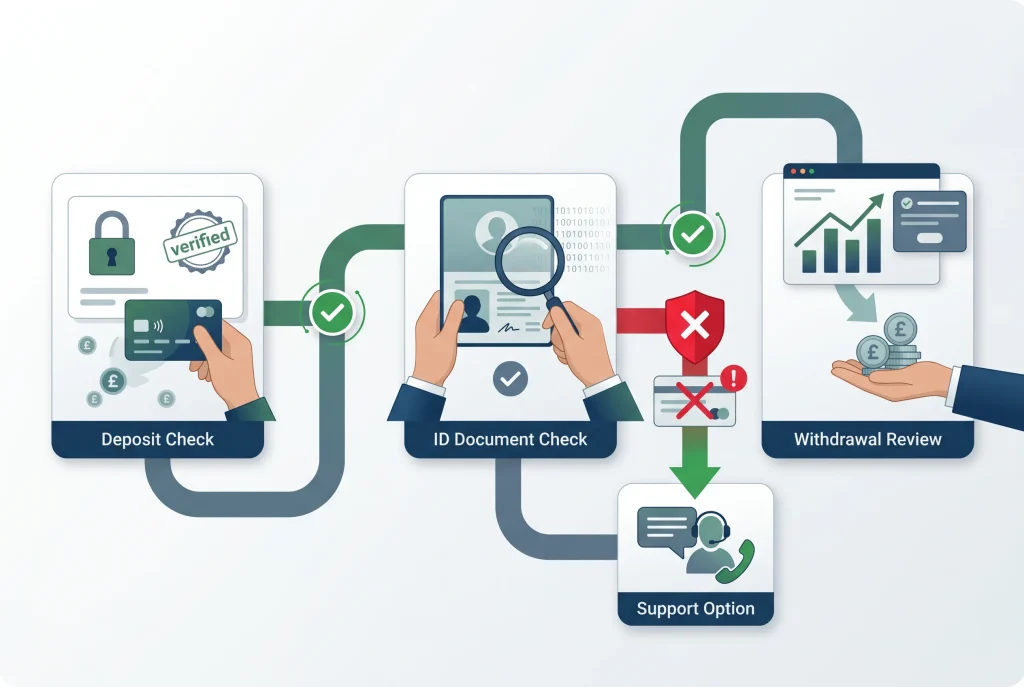
Payment, identity and withdrawal rules are often where a gambling account becomes difficult. A smooth sign-up page does not mean a smooth withdrawal, and a payment method appearing at deposit does not remove verification duties later. This guide explains what to check before deposit, during use and before withdrawal, without promoting anonymous gambling, workaround claims or fast-payout promises.
If your payment has been blocked by a bank gambling block, GAMSTOP applies to you, or you are trying to stop gambling, do not use payment information as a way to keep gambling. Go to GAMSTOP, bank blocks and support options instead.
Mandatory KYC Verification Steps for Fast Cashouts
- Before deposit: check the legal business, the accepted payment source, the identity information requested, bonus choice and customer-funds disclosure. If you cannot find these points, pause before paying.
- While the account is open: keep your own limits clear. If the site contacts you about spending, verification, source of funds or responsible gambling controls, treat the message as a serious account matter, not an irritation to ignore.
- Before withdrawal: expect that identity or risk checks may affect the process. Keep records of what you supplied, when you supplied it and what the business said it still needs.
- If a block applies: do not look for a workaround to a credit-card restriction, bank block, identity check, source-of-funds question or self-exclusion. A block is a signal to stop and consider support.
If a site asks for unusual verification documents, take a moment to check the online casino licence through the official public register.
Age and identity checks are not a minor detail
The Gambling Commission explains that online gambling businesses must verify age and identity before gambling. Consumer-facing information also explains that identity information may include details such as name, address and date of birth, and that risk-based information can become relevant in some cases. This is why “no verification” or “no ID” claims should not be treated as a benefit. They can be a warning sign, especially when connected to gambling that appears to sit outside Great Britain controls.
A sensible check is practical. Before depositing, read what the site says about the information it may ask for, how it checks identity, when documents might be requested and what happens if information is missing or inconsistent. Do not upload altered documents, borrow someone else’s details or look for ways to hide the source of funds. Aside from the obvious account risk, false or evasive information can create serious problems and is outside the purpose of this guide.
There is also a privacy side. If you are sending identity documents, payment information or financial details, the site should give privacy information before collection and explain how personal data is used. The data-security guide covers that in more detail; here, the key point is that verification is part of the payment and withdrawal journey, not a separate afterthought.
Credit-card gambling payments are a clear boundary in Great Britain
Great Britain rules ban gambling operators from accepting credit-card gambling payments. Gambling Commission material also covers credit-card payments made through certain wallet or money-service-business routes where a credit card funds the gambling payment. The safe conclusion is simple: if a payment route is presented as a way around a credit-card restriction, treat that as a serious warning sign rather than a convenience.
This page does not list payment methods for individual operators because those details change and need operator-level checking. Instead, ask broader questions. Is the payment source yours? Does the site explain accepted methods clearly? Are there withdrawal restrictions tied to the deposit method? Does the business ask for extra information before or after the payment? Are there claims that seem designed to get around a rule or a protection tool? A payment option is not useful if it creates account closure, document or withdrawal problems later.
Finding trusted non Gamstop casinos requires a clear understanding of these standard KYC procedures.
What to read before you accept a bonus
A bonus can complicate withdrawals. Gambling Commission guidance says players must be told they can withdraw their deposit balance at any time, including when a bonus is active or pending, subject to general regulatory obligations. That does not mean every bonus-related withdrawal is simple, fast or free from checks. It means you should read the terms that separate deposit balance, bonus funds, winnings, eligibility, expiry and verification.
Before accepting any promotion, look for wagering requirements, time limits, maximum bet rules, restricted games, country or payment exclusions and what happens if you withdraw while a bonus is still active. The bonus and complaints guide goes deeper into promotional terms. On this page, the important payment point is that a bonus choice made before deposit can affect what you understand at withdrawal time.
Withdrawal checks: delay does not always mean the same thing
| What is happening | What to check calmly | What not to assume |
|---|---|---|
| The site asks for ID before withdrawal. | Check whether age and identity verification was described before sign-up and what documents are requested. | Do not assume all document requests are unfair, and do not send false documents. |
| The site asks about the source of funds. | Check what the request asks for, the deadline, and whether the request is linked to account risk or legal obligations. | Do not look for a way to disguise payment source or ownership. |
| A bonus affects withdrawal wording. | Separate deposit balance, bonus funds and winnings. Read the active bonus rules before cancelling or continuing. | Do not assume a headline offer explains the full withdrawal position. |
| The business changes or delays the process. | Keep dated records of requests, replies, submitted documents and withdrawal status. | Do not assume a delay proves wrongdoing, but do not ignore unclear or shifting explanations. |
Customer-funds wording belongs in the payment check
Account balances with gambling businesses are not protected like personal bank accounts. Licensed businesses that hold customer funds must disclose how those funds are held and what level of protection applies if the business fails. This is not a dramatic footnote; it is part of the basic money decision. If you are considering a deposit, find the customer-funds wording before you pay.
Do not use customer-funds wording to build a ranking of unnamed sites. Use it to understand your own risk. If the wording is absent, vague or hard to find, that is a reason to stop and check the broader licence and terms picture. The licence-check page explains how to compare the site’s legal details with public records before you share money or ID.
Warning signs around payments and verification
- A site presents lack of age or ID checks as a selling point.
- A payment route is promoted as a way around a credit-card restriction, bank gambling block or self-exclusion.
- VPN access, crypto or virtual-asset deposits are framed as a way to avoid ordinary account checks.
- Withdrawal rules are only explained after you deposit or accept a bonus.
- Document requests arrive through unclear channels or without privacy information.
- The business gives different reasons for delay without a clear account record.
These points are not a checklist for finding a different way in. They are reasons to slow down, preserve records and consider whether continuing is sensible.
Where to go next
- Check a gambling site before sharing money or ID if you have not verified the legal business and domain.
- Read bonus terms, withdrawal issues and complaint steps if a promotion or dispute is involved.
- Review personal data and account security checks before sending documents.
- Use the support guide if a block, self-exclusion or loss pressure is part of the situation.