
Crazy Time Live Casino Game in the UK: How It Works
 Available in GB
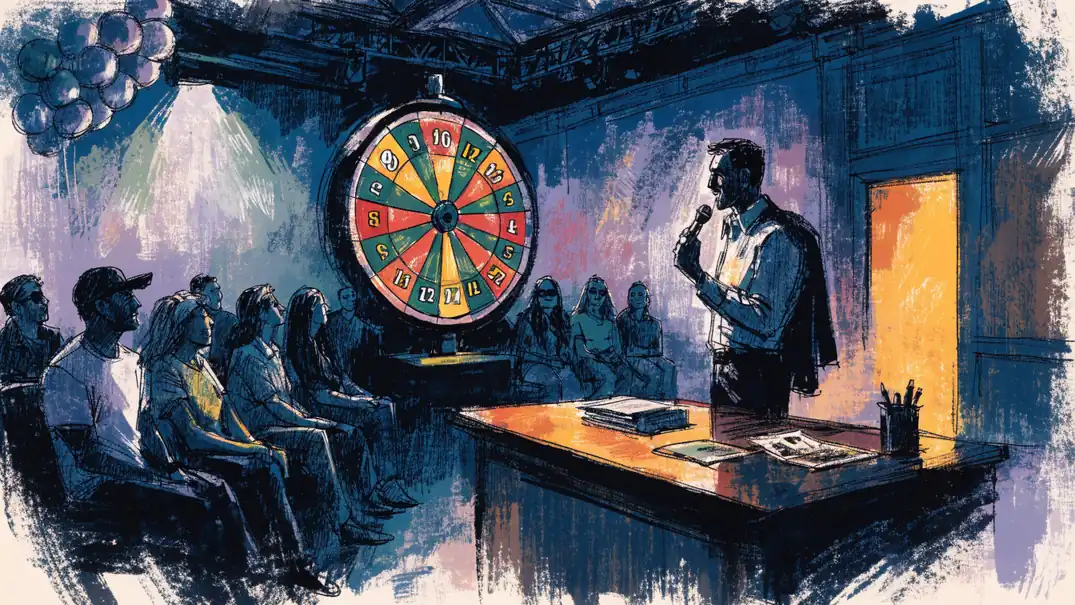
Explore the live game show format, practical access considerations, wheel rules and why past results cannot reliably predict future outcomes.
How Crazy Time Fits into the UK Live Casino Line-up
Crazy Time is a live casino game show developed for streamed play, combining a physical wheel, a studio presentation and real-time interaction. Its format places it between conventional casino gaming and televised entertainment: the outcome comes from a live wheel, while the presentation gives the round a more program-like structure than a standard table game. This is the basis for the interest in Crazy Time casino offers in the UK, rather than the game being treated simply as another digital casino title.
The game sits within the broader live casino category, where a studio or table is transmitted online and a dealer, presenter or croupier conducts the action. The precise interface depends on the operator and the provider’s implementation, but the central distinction remains the same: the game is presented as a live event rather than generated solely by a conventional software reel or virtual table. That distinction matters when comparing Crazy Time with other products carrying the live casino label.
Where Crazy Time sits among live games
The UK live casino line-up includes several different formats:
- Crazy Time — a wheel-based live casino game show.
- Dream Catcher — another wheel-based live product with a studio presentation.
- Lightning Roulette — a live roulette variant with an added random-multiplier feature.
- Infinite Blackjack — a blackjack table designed to accommodate multiple online participants.
- Common Draw — a live casino product built around a shared draw format.
These games should not be treated as interchangeable merely because they appear in the same live-casino lobby. Roulette and blackjack are established table-game categories with decisions or wagers tied to their respective rules. Wheel and draw formats organise the round differently, with the emphasis placed on a central random event and the associated payout sections. Comparisons are therefore more useful when they distinguish the game’s format, rather than relying on the general label “live casino”.
Crazy Time is also distinct from a physical casino table in its presentation. The studio environment, host-led pacing and visual segments are part of the product itself. That entertainment layer may explain why it is often described as a live casino game show, while the underlying wagering remains connected to a casino game governed by defined rules. The description does not turn the outcome into a performance that can be read or predicted; it identifies how the game is presented.
The regulatory setting
In Great Britain, commercial gambling is regulated by the UK Gambling Commission, which is the country’s sole regulator for that activity. Its remit includes online casinos and remote gambling offered to consumers in Great Britain, even when the equipment used to provide the service is located elsewhere. This places a UK-facing live casino within the same regulatory framework as other remote casino products.
The Commission grants operating licences to businesses and personal licences to individuals working in relevant gambling operations. Those categories address different responsibilities: one concerns the business providing gambling facilities, while the other concerns people whose roles require personal authorisation. The regulatory framework is consequently part of the context in which Crazy Time is offered, but it does not change the game’s wheel-based format or make the outcome predictable.
Crazy Time is a live casino game show involving a physical wheel and studio presentation, distinguishing it from standard digital casino titles.
Our top casino picks for the UK
- AmunbetBonus: Join now and get 450% up to 2,700 GBP + 450 FS · Payout speed: 1-3 business days
- DieselwinBonus: Welcome Pack 250% up to £4000 + 200 FS · Payout speed: 1-3 business days
- EvoSpinBonus: 125% up to €2500 + 125 Free Spins · Payout speed: 1-3 business days
- WinBeastBonus: €5000 + 500 FS + €650 Freebet · Payout speed: 1-3 business days
- ZombillionBonus: Welcome Pack 250% up to £4000 + 200 FS · Payout speed: 1-3 business days
- BritsinoBonus: Welcome Package – Get your £2,200 + 2,000 FS · Payout speed: 1-3 business days
Finding Crazy Time at UK Online Casinos
Crazy Time is encountered in the live-casino area of an online casino rather than among conventional digital casino games. An online casino with Crazy Time may therefore present it alongside other streamed tables, game-show formats and dealer-led games. The casino website is the access point, while the game itself is supplied as a separate product within that wider catalogue.
This distinction matters because the presence of a live-casino lobby does not establish that Crazy Time is available there. A site may offer live roulette, blackjack or other studio games without carrying every title from every provider. Conversely, a casino can list Crazy Time among its live games while presenting it under a general “casino”, “live casino” or “game shows” heading rather than using the game name as a prominent navigation label.
Where the game may appear
The most relevant places to check are:
- the live-casino lobby;
- a game-show or wheel-game category;
- the casino’s internal game search;
- a provider or studio filter;
- the site’s rules or game-information pages.
Search and category labels are not uniform across operators. One online casino may place Crazy Time beside roulette and blackjack, while another may group it with other broadcast game shows. A missing tile on the first page is therefore not conclusive evidence that the title is unavailable. The internal search tool, where one exists, may provide a more direct check.
The wording used by a casino can also distinguish between a game being listed and being available for play. A title may appear in promotional material, an indexed game directory or an information page while being unavailable in a particular jurisdiction, account state or technical configuration. Availability should therefore be confirmed from the actual logged-in game lobby and the operator’s current terms, not inferred solely from a general casino page.
What “UK online casino” means in this context
For a British customer, the important issue is not simply whether a website can be opened from the United Kingdom. Remote gambling operators serving consumers in Great Britain are required to hold the relevant licence from the UK Gambling Commission. That requirement applies to the operator offering the gambling service, regardless of where its technical equipment or business offices are located.
The Gambling Commission’s public register is the appropriate starting point for verification. The operator’s legal entity, trading name, domain and licence details should correspond. A logo, licence claim in the footer or reference to regulation is not a substitute for checking the register. The domain matters because a licensed business may operate more than one website, and a licence associated with one domain does not automatically authenticate every other domain using a similar brand.
This check is separate from confirming that Crazy Time is in the catalogue. A casino may be properly licensed but not offer the game; a page may advertise the game but fail to establish that the website itself is authorised for British remote gambling. Both questions require separate verification:
- Is the operator authorised to provide remote gambling to Great Britain consumers?
- Does the operator currently make Crazy Time available through its live-casino offering?
Availability can change
Live-game catalogues are not fixed. Providers, operators and jurisdictions can affect which titles are displayed, and a game may be temporarily absent while a site updates its lobby or access arrangements. A page describing an online casino with Crazy Time is consequently evidence about the page’s stated offering, not a permanent guarantee of availability.
The same caution applies to similarly worded casino websites. A brand name, domain spelling or regional landing page may identify a different operating entity. Licence verification should be performed against the exact website intended for use, followed by a direct check of the live-casino lobby. This establishes the regulatory position and the game listing without treating either one as proof of the other.
Choosing a Casino to Play Crazy Time
Selecting a casino for Crazy Time should begin with the operator’s legal status, not with a prominent banner or a claimed game selection. For customers in Great Britain, a remote operator offering gambling must hold the relevant licence from the UK Gambling Commission. The same requirement applies whether the business is based in Britain or elsewhere, because the decisive issue is that it serves consumers in the British market.
Do
- Verify the operator on the UK Gambling Commission public register.
- Ensure the licence number matches the register.
- Check that the business name corresponds to the gambling service.
Don’t
- Rely solely on a brand name, logo, or website address.
- Assume accessibility from the UK means the operator is licensed.
- Deposit if there is a discrepancy between the site and the register.
A casino’s name, logo or website address is not sufficient evidence of authorisation. The appropriate check is the Gambling Commission’s public register. The operator should be identifiable there under the business name associated with the gambling service, and the listed permission should correspond to remote gambling. A licence number displayed on the website is useful only when it matches the register. If the details conflict, depositing should not proceed until the discrepancy has been resolved.
This distinction matters because offshore casinos can remain accessible from the United Kingdom without being part of the UK regulatory system. Accessibility is therefore not proof of legality or equivalent consumer protection. A site may accept registrations and display a familiar game while lacking the local operating licence required for serving British customers.
Checking the operator behind the website
The legal entity matters more than the marketing label. A casino can trade under a brand that differs from the company named on its licence, so the terms and conditions, privacy notice and licence information should be read together. They should make clear which business operates the account and which entity handles complaints, payments and personal data.
A specialist review can report that a particular brand has been checked, but such commentary is not a substitute for the regulator’s register. The register is the relevant point of reference for the licence status. It is also preferable to check the register close to the time of registration, since regulatory information can change.
Games: Casino Slots, Table Games and Live Casino · Best Progressive Jackpot Slots: How They Work
One published specialist review reported that the Gambling Commission register dated 26 September 2026 did not identify a LuckyPays entry under that brand or its stated domain, including luckypays.io. That observation is tied to the date and to the scope of that review; it should not be converted into a permanent description of the brand. More generally, a missing or mismatched entry is a reason to stop and verify the operator rather than assume that the website is authorised.
Safeguards that should be visible
A licensed casino should provide more than access to a game. Its account environment should show practical controls for limiting gambling activity. Remote operators must prompt new customers to set a financial limit before the first deposit and make account-level limit controls accessible. The available controls should be understandable, usable and located within the account area rather than hidden behind promotional material.
Self-exclusion is another essential safeguard. UK Gambling Commission licensees must provide responsible-gambling tools, including self-exclusion. GAMSTOP may also be relevant for people who want exclusion across participating licensed online gambling services, while an operator’s own self-exclusion facility concerns that particular account or service. These mechanisms are safeguards, not evidence that a casino is suitable for every person or every pattern of play.
Age verification is a further condition of account operation. Operators must verify a customer’s age before allowing funds to be deposited into a gambling account. A site that appears to permit deposits before completing the required checks should be treated as a serious warning sign.
Complaints and accountability
The casino’s terms should explain how an internal complaint can be made. UKGC licensees must operate an internal complaints process and provide access to an approved Alternative Dispute Resolution service. The relevant procedure should identify the stages of escalation and the role of the ADR provider. Vague references to “support” do not demonstrate that this process exists.
Attention UK-licensed casinos are prohibited from accepting credit cards for gambling or using credit-card funding routed through money service businesses.
The same scrutiny applies to payment arrangements. UK-licensed casinos cannot accept credit cards for gambling, and remote operators cannot accept credit-card funding routed through a money service business. A wallet that permits credit-card funds to be used for gambling is also excluded. Payment methods therefore provide a useful consistency check: a site presenting prohibited funding routes would not align with the requirements applying to a properly licensed British-facing operator.
A restrained selection standard
No ranking is needed to establish whether a casino merits further consideration. A defensible assessment can be reduced to several checks:
- The operator is identifiable as a legal entity.
- Its remote licence is current on the Gambling Commission register.
- The registered details correspond with the website and account terms.
- Age verification occurs before deposits are permitted.
- Financial limits and self-exclusion tools are available.
- The complaints process and approved ADR route are explained.
- Payment options comply with the prohibition on credit-card gambling.
Only after these conditions have been examined does the presence of Crazy Time become a meaningful selection factor. Even then, the game’s availability does not establish that the casino is safe, suitable or preferable. Gambling should remain limited to money that can be afforded to lose, and a casino that cannot demonstrate the required safeguards should not be treated as an acceptable destination.
Playing Crazy Time: Access and Practical Considerations
Finding Crazy Time in a casino’s live-games area and being permitted to play are separate matters. A title may appear in a lobby while access remains unavailable until the operator has completed the required checks and the account satisfies its payment and control conditions. The practical process therefore involves more than locating a table labelled Crazy Time, Crazy Time Wheel or a comparable live wheel game.
Account access and age checks
Remote gambling operators must verify a customer’s age before allowing funds to be deposited into a gambling account. This means that registration information and identity checks can affect access before a wager is possible. An account that has been created but not yet verified should not be treated as ready for real-money play.
Casino Dice Games in the UK: Tables, Slots and Searches
The legal age for online gambling in the UK is 18, provided that the operator holds the relevant UK Gambling Commission licence. Age verification is therefore not merely an administrative inconvenience: it is part of the conditions under which a licensed operator may accept gambling activity. The same principle applies whether Crazy Time is opened from a live-casino menu, a direct game page or a mobile interface.
Location also matters to the operator’s obligations. Remote gambling offered to consumers in Great Britain falls within the Gambling Commission’s regulatory remit, regardless of where the equipment supporting the service is located. A page that loads successfully is not, by itself, evidence that the account is authorised for play or that the operator is permitted to serve the British market.
Deposits and payment restrictions
A funded account is subject to payment rules that affect the practical route into the game. UK-licensed casinos cannot accept credit cards for gambling. The restriction also covers credit-card funding routed through a money service business, as well as wallet payments where the wallet permits credit-card funds to be used for gambling.
Payment restrictions
UK-licensed casinos cannot accept credit cards for gambling. This restriction also covers credit-card funding routed through a money service business, as well as wallet payments where the wallet permits credit-card funds to be used for gambling.
Consequently, a failed deposit does not necessarily indicate a technical problem with the Crazy Time table. The payment method itself may be unsuitable for gambling transactions. The available route must be assessed through the casino’s stated payment arrangements, without assuming that every method shown elsewhere on the internet can be used for a UK gambling account.
Limits before play
Remote operators must prompt new customers to set a financial limit before the first deposit. They must also provide accessible controls for limits at account level. These controls are relevant before opening a live game, because the ability to wager is connected to the account’s financial settings rather than only to the game interface.
An account may therefore be technically able to display Crazy Time while its deposit or wagering conditions prevent immediate play. Limits are not evidence that a game is unavailable; they are account safeguards that shape whether and how funded gambling can proceed. Any decision to participate should remain within money that can be afforded to lose.
Mines Casino Game UK: How It Fits and What to Know
The same distinction applies across desktop and mobile access. Changing the device may alter how the lobby is displayed, but it does not remove age verification, payment restrictions or account-level controls. Opening the Crazy Time wheel is consequently the final step in an access process, not a substitute for meeting the conditions that govern the account.
Crazy Time Strategy and the Limits of Prediction
A strategy for Crazy Time can govern decisions made before and during play, but it cannot establish which result will appear next. The wheel’s previous outcomes do not create a dependable pattern for the following round. A sequence containing the same segment several times, for instance, does not make another result more or less obligatory. Treating recent history as a forecast can turn ordinary random variation into a misleading signal.
What a sensible strategy can address
The useful part of a live-casino strategy is therefore organisational rather than predictive. It may define:
- the amount set aside for gambling;
- the maximum loss that ends a session;
- the point at which winnings are withdrawn rather than returned to play;
- whether a session is stopped after a predetermined period;
- which wagers are acceptable before the round begins.
These decisions can reduce impulsive changes, particularly after an unexpected loss. They do not change the mathematical prospects of any outcome. A staking plan is a way of controlling exposure, not a method for identifying a winning result.
Loss-chasing is especially incompatible with that distinction. Increasing a wager to recover an earlier loss does not make recovery more likely. Nor does reducing a wager after a win protect against a subsequent loss in any predictive sense. The amount placed on one round cannot influence the wheel’s outcome.
Any plan should also account for the possibility that the reserved funds may be lost. Gambling should be limited to money that can be afforded to lose, with essential expenditure and financial obligations kept separate. If maintaining a fixed boundary becomes difficult, continuing the session is not a strategy problem but a reason to stop and use available gambling-support measures.
Trackers and historical records
A Crazy Time tracker can record completed rounds, selected segments, or other visible results. Such a record may help with reviewing personal play: it can show how often sessions were extended after losses, whether wagers became larger under pressure, or how quickly a pre-set budget was used. It cannot reliably predict the next wheel result.
A Crazy Time tracker can record completed rounds and visible results for personal review, but it cannot be used to predict the next outcome.
The same limitation applies to websites, spreadsheets, streams, and applications that present streaks or recent frequencies. A chart can describe what has already occurred, but description is not evidence of a causal trend. A claim that a segment is “due” confuses an expectation over a long run with a forecast for the immediate next round. The fact that a result has appeared infrequently does not require it to appear soon.
A tracker may also create an impression of control by making random outcomes look orderly. That effect is a reason to interpret records cautiously. Unless a tracker explains a verifiable mechanism that changes the game itself—which a player-side record cannot do—it remains a logging tool.
Why history does not supply a system
The history of casino games illustrates a recurring separation between observing outcomes and controlling them. Past results can be documented, compared, and displayed, yet that historical information does not provide a rule for selecting the next outcome in Crazy Time. A “system” based on alternating colours, missing segments, or apparent wheel cycles is consequently a pattern-reading exercise, not a demonstrated prediction method.
Rules about stake limits should not be imported without checking the game’s classification. A specialist review has described Great Britain’s online slot limits as £2 per game cycle for adults aged 18 to 24 and £5 for adults aged 25 or over; that description is not treated here as a general rule for Crazy Time. The same type of review states that those slot limits do not extend to roulette or blackjack. Classification and applicable rules should therefore be confirmed with the licensed operator rather than inferred from a strategy guide.
Deal or No Deal Casino UK: Slot Features Explained · Classic Slots Online UK: Spins, Symbols and Play
Is Crazy Time a Slot? Understanding the Game Category
Crazy Time is a live casino game show rather than a conventional online slot. Its presentation may create confusion: it has a large wheel, changing visual effects and bonus features, while searches for casino games often group very different products under the same broad terms. Classification matters because the rules and safeguards attached to online slots are not automatically transferable to live casino games.
A slot normally generates outcomes through software and presents repeated spins or game cycles. Crazy Time instead uses a live studio format in which a presenter operates the wheel and the result is shown in real time. That places it alongside other live casino products, even though its entertainment style differs from roulette or blackjack. The word “casino” describes the gambling setting; it does not mean that every game offered there belongs to the same regulatory category.
Why the distinction affects stake rules
Great Britain has specific controls for online slots. A specialist review has reported that the permitted stake for a slot game cycle is £5 for adults aged 25 or over and £2 for those aged 18 to 24. That information should not be treated as a general rule for every casino product, and it is subject to the applicable regulatory position at the time of play.
Online Slot
A game that typically generates outcomes through software and presents repeated spins or game cycles.
The same specialist review distinguishes those slot controls from roulette and blackjack, stating that the limits do not apply to those games. Crazy Time should therefore not be classified as a slot merely because it is displayed on an online casino website or because a search page places it beside slot titles. The relevant category is determined by how the game operates, not by the name of the casino or the layout of its lobby.
This distinction also explains why descriptions of Crazy Time that refer to “spins” can be misleading. Casual wording may describe a round or wheel result, but it does not establish that the product is an online slot. A live wheel outcome and a software-generated slot cycle are different forms of game presentation.
What “casino bonuses” can mean
Promotional language can add to the uncertainty. A casino may describe an offer as applying to live games, casino games or selected products, but the title of the promotion does not establish that Crazy Time is a slot. The applicable terms determine which games qualify, how contributions are treated and whether separate restrictions apply. Those details belong to the promotion itself, not to the classification of the game.
Crash Casino Game UK: Categories and Fairness
The same caution applies to references to the “best” casino for Crazy Time. A casino’s inclusion of the game says little about its category. It is also insufficient evidence that a bonus applies to it. Game type, promotional eligibility and operator status are separate questions.
Interpreting Crazy Time results
A reported Crazy Time result normally refers to the segment selected by the wheel in a particular round, together with any feature or multiplier associated with that outcome. It is not a slot result in the technical sense simply because it is displayed as a recent-results history. A results panel records completed rounds; it does not alter the nature of the underlying game.
Past results likewise do not turn the game into a slot or establish a reliable forecasting method. The visible record may help identify what has occurred, but classification and prediction are separate matters. Terms such as “casino result” can be broad descriptions of an outcome rather than evidence about the game’s regulatory category.
For that reason, Crazy Time is best understood as a live casino game show with a wheel-based format. Slot-specific assumptions should be checked rather than carried across automatically, particularly when considering stake controls, promotional terms or the meaning of displayed results. Regardless of category, gambling should be limited to money that can be afforded to lose.
Summary
- Crazy Time is a live casino game show, not a conventional online slot.
- Regulatory compliance and UK Gambling Commission licensing are essential for UK players.
- Safeguards like age verification, financial limits, and self-exclusion are mandatory for licensed operators.
- Past game results do not provide a basis for predicting future outcomes.
Free Play, Demos and What They Can Show
Free access to Crazy Time can mean several different things. A casino may display the game without requiring an immediate wager, a provider may make a demonstration version available, or an information page may show the interface while explaining the rules. These arrangements should not be treated as equivalent to playing the live game for money.
A demo is primarily an orientation tool. It can show the visual layout, the wheel, the available sectors and the sequence in which a round is presented. It may also help clarify terminology used in reviews of Crazy Time and make it easier to follow explanations of multipliers or bonus features. That makes a demo potentially useful for understanding the product category, but it does not establish how a particular operator conducts real-money play.
What free access can demonstrate
A non-wagering version may help identify several practical features:
- how the game screen is arranged;
- where the wheel and betting controls appear;
- how round information is displayed;
- how the presenter communicates with players;
- how the result is announced and recorded.
This type of inspection can be relevant when comparing descriptions of the live casino format. It can also show whether the interface is understandable before any account is used for gambling. A review based on observed presentation may therefore be useful, provided it distinguishes direct observation from claims about an operator’s licence, policies or customer service.
Free access cannot, by itself, verify that a casino is safe for real-money gambling in the United Kingdom. It does not confirm the operator’s regulatory status, the identity checks applied to funded accounts, the available account controls or the handling of complaints. Those are separate matters. A polished demonstration environment is not evidence that the associated gambling service meets British requirements.
Free spins and free rounds
The expression “free spins” can be misleading when applied to Crazy Time. It may refer to promotional wording, a game feature, or informal language used by a review site. It should not be assumed to mean that a real-money account can access the game without conditions. Any offer attached to an account belongs to the operator’s promotional terms and should be assessed separately from the game’s demonstration mode.
Chicken Road Game Casino UK: Formats and Evidence
Nor does free play establish that a casino offers a particular promotion. Availability can vary by operator, account status and the terms presented at the time. A page describing free access may be discussing a practice environment rather than an inducement connected with deposits or wagering.
Limits of a demo-based review
A demonstration can show the mechanics and general presentation, but it cannot reproduce every feature of funded play. It may omit identity verification, payment processing, financial-limit prompts, responsible-gambling controls and the internal route for complaints. It also says nothing conclusive about whether an operator appears on the public register of the UK Gambling Commission.
For that reason, reviews of Crazy Time should separate three judgements:
- Game presentation: what the interface and live format show.
- Practice value: whether the free version helps explain the flow of a round.
- Operator suitability: whether the gambling service is authorised and provides the safeguards required for British customers.
The third judgement cannot be inferred from the first two. Before any deposit, the operator’s licence number should be checked on the Commission’s public register. Age verification is required before funds can be deposited, and gambling should be limited to money that can be afforded to lose. A free demonstration may support informed understanding, but it is not a substitute for those checks or for responsible decision-making.
Bonuses, Deposits and Account Safeguards
A Crazy Time promotion is normally part of the casino account rather than a feature of the game itself. A welcome offer, deposit promotion or reward described alongside the game may therefore have conditions attached to the account, the qualifying payment and the subsequent withdrawal. The presence of a promotional message does not establish that the offer is available to every customer or that it applies specifically to Crazy Time.
Before making a deposit, the relevant terms should be read in full. Important points include which games count towards an offer, whether live games are included, any wagering requirement, the permitted payment methods, expiry conditions and restrictions on withdrawing funds connected with the promotion. A “no-deposit” description also requires careful treatment: it does not necessarily mean that no account verification, payment method or other eligibility condition applies. The casino’s current terms are the controlling document, not a headline or banner.
Operator Checklist
- Verify the operator on the Gambling Commission register.
- Confirm the licence allows remote gambling.
- Check that age verification is completed.
- Set financial limits before your first deposit.
- Ensure the payment method is permitted for UK gambling.
Deposits at a UK-licensed casino must be made without a credit card. The restriction also covers credit-card funding routed through a money service business and wallet payments where the wallet permits credit-card money to be used for gambling. This can affect an apparently suitable payment route even when the casino does not present it as a credit-card transaction.
Remote operators must verify age before allowing a customer to deposit. They must also prompt new customers to set a financial limit before the first deposit and provide accessible controls for changing account-level limits. These controls are separate from a bonus: accepting a promotion does not remove the ability to set spending boundaries or use other responsible-gambling tools.
UKGC-licensed casinos must provide self-exclusion and other responsible-gambling measures. GAMSTOP is a separate national self-exclusion service, so references to casinos “not on GamStop” should not be treated as evidence of a safer or more suitable bonus option. Offshore operators fall outside the UK Gambling Commission system; a site serving Great Britain for real-money gambling must hold the relevant local licence.
Any assessment of payouts should therefore include more than the advertised speed or promotional wording. The operator should display its licensing information, complaints procedure and access to an approved Alternative Dispute Resolution service. Funds should not be deposited until the licence number has been checked on the UK Gambling Commission’s public register. Gambling should remain limited to money that can be afforded to lose.
Crazy Time Rules, Scores and Multipliers
Crazy Time is a live wheel game. A presenter starts each round by spinning the wheel, and the result determines whether the outcome is a numbered segment or one of the named bonus segments. The essential rule is that the winning segment is selected by the wheel; the player does not choose a card, number or position after the spin.
Online Casino Games for Real Cash in the UK
The numbered sections are commonly treated as straightforward outcomes: a result matching the selected number produces a payout according to that segment’s stated value. The bonus sections work differently. They lead to separate bonus rounds, each with its own presentation and scoring method. The relevant rules are displayed in the game interface, so the bonus name alone should not be treated as a complete description of its settlement process.
How scores and multipliers work
“Scores” in Crazy Time generally refers to the winning result and the payout calculation shown for the round, rather than to a cumulative player ranking. A multiplier is an applied factor that can increase the payout attached to an eligible outcome. It does not change the wheel’s result, guarantee a win, or make the next round more predictable.
A multiplier may be associated with a result during the main game or appear as part of a bonus round, depending on the event shown by the table. The exact settlement depends on the segment and the rules presented at that stage. Consequently, the displayed multiplier should be read together with the winning symbol and the applicable bonus instructions, not in isolation.
The game’s visible history can record previous results, but that record is descriptive rather than predictive. Past scores and multipliers do not establish what the next spin will produce. Any explanation of live casino rules that presents them as a forecasting tool goes beyond the mechanics of the game. Regardless of the outcome, gambling should be limited to money that can be afforded to lose.
Are online casino games licensed and regulated?
Yes. The UK Gambling Commission regulates online gambling offered to consumers in Great Britain, and remote operators serving them must hold the relevant licence.
What are the online slot stake limits in Great Britain?
The limit is £5 per game cycle for adults aged 25 and over and £2 for adults aged 18 to 24. These limits do not apply to roulette or blackjack.
Is LuckyPays licensed by the UK Gambling Commission?
The Gambling Commission register dated 26 September 2026 does not show an entry for LuckyPays or its stated domain, luckypays.io.